 <rant on self>
I started a new job the week of Thanksgiving, and have been wrapped up in learning the ropes around there, getting a Christmas tree, meeting with friends, and thinking really really hard about blogging. But not actually typing any words. Thing is, my brain's been so full of not-bloggy stuff that I'm having trouble thinking of a good essay. But the point of the blog isn't to be good (yet!), it's to be disciplined about the writing part. Ok, here goes...
</rant>
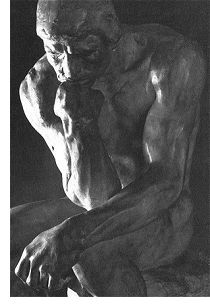
I like to think about thinking. For as long as I can remember, certainly back into the late '60s, I've been fascinated by the idea that people can think in ways that dogs or even trees or rocks can't. (Ok, to be fair, I've been told on occassion that I think about as well as a rock...) Anyway, not only the fascinating thoughts, themselves, but the whole idea -- the mechanism of thinking is extremely interesting to me.
So, of course, when I started learning about computers, dabbling in artificial intelligence seemed only natural. Thing is, lots of people much-much smarter than I had been doing this for a dozen years and had far greater design and programming skills than I, so the field seemed hopelessly beyond my grasp. Still, it's interesting to think about how we think -- I mean how we can think at all -- and look for little rules, patterns and systems related to our thinking.
Heh -- one funny thing about the AI world seeming so far ahead of me that I could never catch up: in high school, it seemed to me that the main flaw of the then-popular AI efforts (and by "popular", I mean the ones you read about in the magazines, journals & newspapers) was that everyone seemed to be trying to codify an artificial "fully formed adult" -- one who could speak English, carry on intelligent conversation, make decisions, jokes, laugh at your jokes, etc. It seemed to me that, if the attempt to mechanize intelligence were to have any chance, whatsoever, it would have to stem from a much more organic approach -- one in which one automated the very rudamentary mechanisms of thought, perhaps priming it with very basic instincts (like, maybe, survival, curiosity and mimicry), and then allow it to evolve into something smarter. Of course, one would likely have to make several false-starts, and deal with dozens or hundreds of failed attempts -- but the key, I thought, was to make the underlying structure have as LITTLE pre-programmed ideas as was possible.
I'm now learning that modern AI is "discovering" this area and developing it, with some success and great promise. I take some pride in knowing that I "invented" this back in the 70s. If only I'd-a thought to try to patent it, or something ;)
Hey, one pretty-smart idea in 30 years -- not bad!
 Anyway, I don't do much in the way of AI-tinkering, anymore. I do a little games programming, and my AIs always have a bit more "organic" feel than most, but they're still pretty simple "look around for an enemy, shoot at it"-type of things. Still, I like to think that my NPCs add color to an otherwise all-to-predicatble game.
But, while I don't do much in the way of AI programming, I still think it's just fascinating that people can think. I mean, a couple of pounds of wet hamburer between our ears manages to make electrical firings that put out blog entries like this one. Ok, maybe not so impressive but, if you add up all of us, we published the entire internet, including The Wikipedia!
It's funny -- I have a fair number of pretty smart friends, and none of them really get all that excited about this stuff. "Yeah, yeah -- people think; whoop-dee-doo." Ok, maybe they don't say that, but it seems that way, some times...
One of the weird things about thinking about thinking is trying to think about how other people think and how, given information very similar to information that I have, they can come to conclusions substantially different from the ones I do. Of course, much of this has to do with background, education/brainwashing, etc. -- certainly much of the "similar information" that is obvious is really only a very teeny-tiny part of the whole gestalt of who we are and what we know, so the fact that we share 95% of the information regarding some small situation that happened in the past 10 minutes maybe shouldn't be so surprising that we see it differently, based on 20, 30, 40+ years of different backgrounds.
Heh, thinking about thinking -- I just realized that I've written several paragraphs on some of the odd things related to how fascinating I think thinking about thinking is, but haven't really said much about what it is that's so fascinating about thinking (or meta-thinking.) See...? Now I think that's interesting! Ok, it doesn't make for very captivating reading, but it's interesting to think about! To me, anyway.
Yeah, yeah -- "big whoop-dee-doo..." <sigh>
 One weird side-effect of all of this is that I wrestle with determinism (vice free will.) Yes, I understand that some claim that the two are not incompatible, but that just strikes me as ...hmm... "not fully honest." I mean, saying "the illusion of free will is so strong that it may as well be true, even if we're all just programmed to believe it" doesn't seem like much of an argument for free will. Anyway, I tend to try to ignore the determinism thing, because it tends to make me sad. But then I start thinking that maybe it's just my destiny to feel that way, and that I'm just following my programming (along with my universe-provided inputs), and that maybe, sometimes, it'll make me happy, too. Or maybe my brain is wired in such a way as to remember that determinism makes me sad ("sad"'s not the right word -- but it puts me in a sort of quiet & reserved mood), but that's just the stored-memories, and I was really quite giddy about it. Of course, that doesn't really fit and, if you can't trust your memories (the ones you remember, I mean! :), well, then you've got bigger problems... Still, the knowledge that neurons just fire their little chemical do-jobs whenever they get properly tickled by nearby neurons (with certain time-to-refire constraints) seems to lead pretty conclusively that, given one's brain-state at any given moment and the world around them at that moment (which produces various stimuli on the sensory neurons for temperature, light, sound, etc.), there seem to be only one possible next-instant of brain state, and that sure sounds a lot like determinism to me!
Heh, I didn't intend for this to turn into an entry about free will (been reading a bit about that over in Scott Adams' blog), but such is my programming that it turned out that way... Actually, when I get to thinking about this stuff, that's when I start to feel more religeous, as I keep hoping that there must be some sort of "spirit" ("soul"?) that accounts for the free-will portion of our beings that can act outside of the "normal laws of physics."
Of course, everything has to follow some set of "laws of the universe" -- that's part of being part of the universe! -- but maybe there's some "other layer", similar to "another dimension" in science-fiction, but really more like "another layer" of a story, that makes it all work & make sense (and gives us free will!) Of course, I can't imagine in the least how such a thing might work, but I like to imagine that it does, somehow, just so I don't have to feel all pre-destined.
...On the other hand, maybe I have to want that, because it's my destiny. <sigh>
Ok, ok... kind of a dopey entry -- but at least I got out some words. Next year, I'll work on upping the quality; after I get the "write regularly" discipline down.


 Actually, before I launch into that, I read an interesting thought about controversy that I want to share. I'll be exploring this idea further in a future blog. The gist of it is this: controversial ideas are ones that people are afraid might be true. Basically, if I say "the moon is made of green cheese", that's not particularly controversial, because nobody really believes it and nobody really cares -- it's "whacky", but not "controversial." On the other hand, if I say "there is [an/no -- choose one] all-powerful God who created the heavens and Earth", folks will get all crazy and line up on either side, ignoring each other, shouting their positions and sometimes even going to war over their fear that somebody might believe the other side of the argument. That's controversial!

 And even though I'm sure you're all very nice people, I don't really know the rest of the folks who surf the internet well enough to pass along any particularly strong sentiment. I do, of course, wish you a very happy holiday season, continuing through the next year and all the rest of your days. You get that one for free, just for being human. Heck, I even hope Sadaam has a nice Christmas, whatever that means for him...
 Being "not much of a cell phone guy", I tried to get the hang of it -- I carried it almost everywhere, and tried to integrate it into my life. The cell phone part was somewhat convenient, but it seemed that more than 95% of my calls were to 911 to report accidents or roadside brush fires. Actually, I think the first "real" call I ever made (not counting calling my wife to tell her "write down this number, since I can't remember it") was to call the fire department to report a chimney fire we witnessed while out on an after-dinner walk. That was a pretty nice feeling! (NOTE: if you see flames shooting out of the top of someone's chimney, that's A Problem. If it's not wrestled under control in a matter of seconds, the entire house can be lost rather easily.)
 I often wondered if it would've been easier if the current units supported Graffiti, Palm's stylus-scribble-recognition system[1]. It seemed to me that if I could write on the screen with a sytlus & scratch-out text & drag a pen across it like a mouse to drag&drop things here & there, it might've clicked in my head. But I guess I can only speculate, there.
 But the really cool thing about all of this is: I recently started using an idea-keeper pad, and I'm totally loving it! Over the years, I've jotted down this or that idea here and there, or started a small notebook to collect ideas on some project or another (i.e.,


 I think that if I had a genie who would grant me one work-improvemet-related wish (or pick your favorite mechanism for dictating exactly one change-by-fiat to make work better), it'd be that any time anyone could call-out one of the decision makers as engaging in wishful-thinking, the decision under consideration would be tabled until they could demonstrate a thorough risk analysis and that their idea contains more fail-safe consideration than the likely-to-bite-you-in-the-ass kind. If I could figure out a way to word it so that people who attempted to massage the metrics to give a better impression than indicated by reality felt pain according to the level of dishonesty, I'd stick that in there, too.
 I often make the analogy of using a cash-advance from one's MasterCard to pay one's Visa bill, and vice versa. While it's crazy, of course, one can see the allure -- I mean, it gives the immediate appearance that one can "buy" all sorts of nice things that one really couldn't otherwise afford, and never have to "pay the piper", so to speak. What I don't get is how otherwise very-smart, very-together people can not see how this sort of behaviour is something to be avoided at all costs, used only in an extreme emergency, as it comes with a tremendous "next month's bill" overhead. Heh, well, I suppose I do get it -- because these otherwise smart and together people spend so much of their lives in a state of emergency that it has become their "normal routine" to apply weird, extreme, emergency procedures to just about everything they encounter.


 I think the first dinners were on Monday nights, but something came up that interrupted them, so we switched to Wednesdays. Back then, we were both single and so a lot of our Wed-night dinner talks centered around the trials & tribulations of dating (note to self: do a blog on dating strategy), and how we could enjoy that process more. One thing led to another, and it's been Tuesday nights for the last many-many years, and we've come to refer to it as "Tuesday Night With Mikey" or "TNWM", for short.

 I'm a bit of a packrat. Actually, I come from a long line of packrats -- my mom was a packrat, and her parents were packrats and her grandfather (my great-grandfather) was SUCH a packrat that he had to have a

